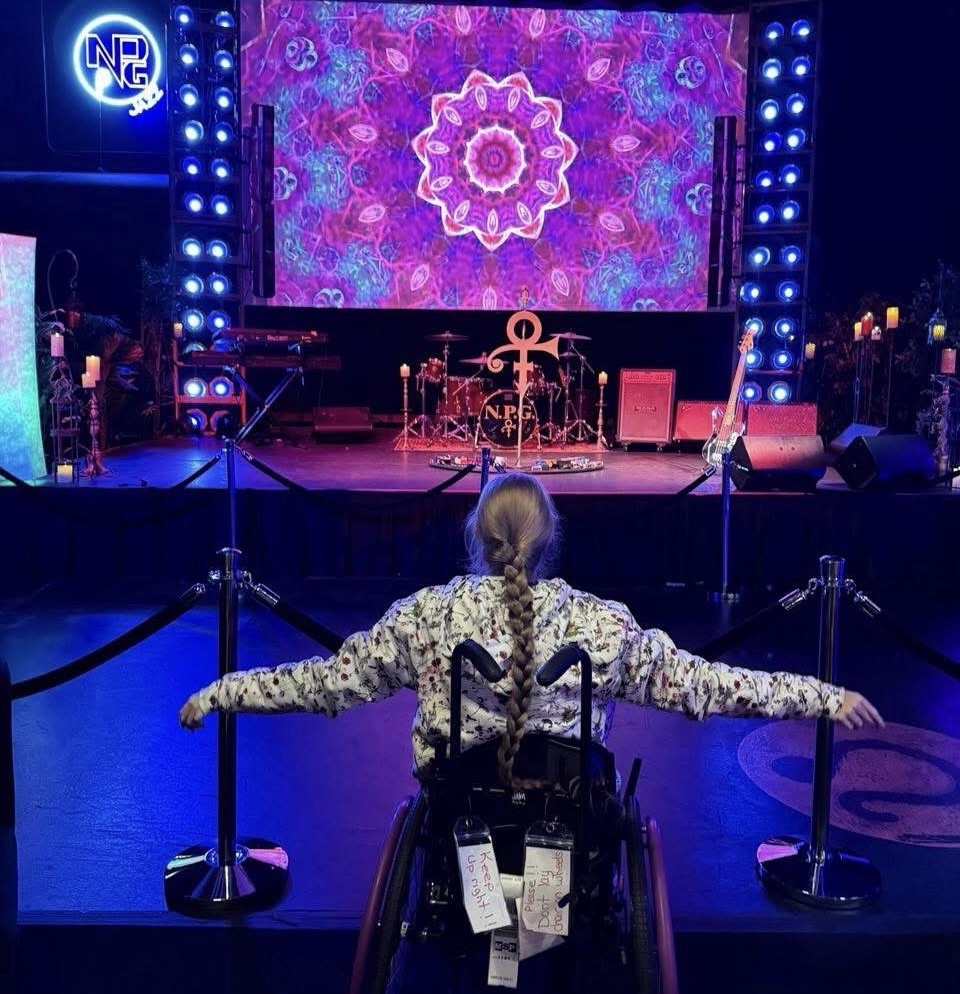
Do you have a disability, use a mobility aid and have wanted to visit Prince’s Paisley Park, a museum located on the outskirts of Minneapolis, but have hesitated due to not knowing how accessible they are?
Then this two part accessibility guide is for you! This blog post goes beyond the general information on their website and describes parking, medical devices such as Dexcom, a room by room description of my own tour experience, and more!
Before You Arrive
Parking:
There is handicap parking located in the front and back of the parking lot. During events, if a handicap placard is shown, you can park for free without purchasing a parking pass.
Electronic Devices:
Any electronic devices such as cellphones, cameras, smart glasses, etc will be locked in a pouch before entering Paisley Park. They will be unlocked once you enter the soundstage area. From my understanding there are no exceptions made for medical devices like Dexcom. Please email to verify.
Caregivers:
Unlike other museums that allow caregivers in free or at a discounted rate as long as the person with the disability they are with purchases a ticket, this isn’t something Paisley Park offers.
KultureCity:
To my knowledge, the museum is not registered with KultureCity.
Sensory Bags:
In my experience, they do not offer sensory bags for any of their experiences. However, I have never asked. I would email them to verify this as well.
Sensory-Friendly Tours:
Sensory-friendly tours such as lowered sound volume and lowered lighting, are not publicly advertised as an option. I believe they do offer private as well as group tours, but not for this purpose specifically. This is also something I recommend emailing about to verify.
The Experiences
Paisley:
This tour is considered the general tour. It consists of the main level, including an area called the Atrium, as well as Studio A where Prince recorded, produced, and mixed music. It also includes The Soundstage where the musical icon rehearsed and held private events, and the last area of the tour is called the NPG Music Club, which was known for his ‘After Dark’ parties.
VIP:
This is the next tour that is available. It is mostly the same as the Paisley experience but with access to The Editing Room located within the Atrium, additional content, and rare archives. You also experience Studios A & B, including a photo opportunity in Studio B.
Ultimate:
This is the last tour available and it is not only the longest, but it also showcases exhibits and archives that are not available on the Paisley or VIP Experience. It offers the same exhibits in the beginning but not only do you see things you wouldn’t see on the other tours, but you also have the opportunity to have a special audio playback session in Studio B. A photo opportunity is also included.
The Paisley Experience
Room by room (in-depth accessibility descriptions)
The Atrium:
The Atrium Itself:
Once guests check-in, this is where all tours begin. This is a huge open space with plenty of room for those using mobility aids to navigate without having to worry about hitting their knees or bumping into the people around them. Multiple mobility aids can fit, no matter their size.
The Little Kitchen:
This exhibit has a large entryway where multiple mobility aids could fit, if it’s not crowded. You do not go inside the space itself but if you did, due to the layout, one or two mobility aids could fit without the individuals using them worrying about bumping into the things around them on accident.
Sign O’ The Times Room:
Although the exhibits I described above were large spaces where multiple mobility aids could fit without issues, there are rooms located within the Atrium that are very small, which includes this one. This exhibit has outfits, plays videos, as well as has artifacts from this particular era. Due to its room size, one or two mobility aids could fit at a time. It could feel cramped if crowded, which could cause individuals to accidentally bump into the things (or people) around them.
Diamonds and Pearls Room:
This is another smaller exhibit within the Atrium. Like the Sign O’ The Times room, it has artifacts, plays videos as well as showcases outfits from this era. One mobility aid can fit at a time and it can feel cramped as well, if a tour is crowded.
Prince’s Office:
This exhibit is a little bigger than the Sign O’ The Times and Diamonds and Pearls rooms. There is an enter and exit doorway but the size of the space itself is on the smaller size and sort of cramped, even if there is not a lot of people touring. Due to this, you are led through a particular way and this could cause accidental bump-ins. One mobility aid could fit, in my opinion.
Introduction Room:
This is the room where you watch a video that introduces Prince and Paisley Park. The space is of small-ish size but only because of the benches that are in the middle of the room. If crowded, one mobility aid could fit comfortably. However, if a tour is not crowded, multiple could fit without issues.

The Galaxy Room:
After exploring the Atrium, tours are led here to the Galaxy Room, which is a back-lit ultraviolet room. A video of Prince plays as well. The room itself is spacious but because of the way tours are led through this particular exhibit, space is limited and could be tight. Due to this, not many mobility aids could fit in here comfortably. From my observation, I think one could fit depending on its size. However, I have personally bumped my knees a few times so just please just be aware that the floor size looks much bigger than it is, from what I’ve seen.
Studio A:
This is the only studio you will visit during this tour. Is is extremely spacious and although there are some artifacts, including a recording booth and equipment behind glass, there is plenty of room for multiple mobility aids to fit without worry about bumping into people or their surroundings.
Purple Rain Room:
After Studio A, comes the Purple Rain Room. Much like the studio, this exhibit has the space for more than one mobility aid (wheelchair, walker, arm crutches, etc) to fit and navigate without any issues.
Hallway of Inspiration:
I feel like hallway space is important to mention because although most of the exhibits are very accessible, the hallways can be very small and difficult to maneuver, especially the Hallway of Inspiration, which is a mural Prince had created to showcase who inspired him, who he was inspired by, as well as who he mentored and collaborated with. This hallway is tiny and I have personally bumped into the people around me and the wall itself. Based on my experience, one mobility aid could fit just be aware that you could possibly be in a very crowded space.
Emancipation Room:
This exhibit is the last one guests visit before their electronic devices are unlocked. This room is smaller than the Purple Rain Room and Studio A, but is still a fairly big space. It is filled with artifacts from one of the biggest periods in Prince’s life (the 90s, when he changed his name to an unpronounceable symbol), and two videos play a few feet away from where everyone gathers. If the tour isn’t crowded, multiple mobility aids could fit in here comfortably whereas if it is crowded, only one could fit completely, but would more than likely accidentally bump into their surroundings.
The Soundstage:
The Soundstage is the second to last stop on all of the tours and it’s also where phones, cameras, etc are unlocked and given back. Not only is it filled with artifacts, but I’d say it’s one of the biggest spaces in the museum. In my opinion, 10 mobility aids, if not more, could fit in the Soundstage, no matter the size of an individual’s wheelchair, walker, etc. A video montage is played and before you know it, individuals are led to the last stop.

NPG Music Club:
The NPG Music Club is officially where all tours end. This space was known for Prince’s After Dark parties and is now a fully functioning cafè that serves, coffee, sodas, teas, and cheesecake. It is a small space and people are not as spread out due to being stopped right before the velvet rope that separates the stage area, which is technically part of the tour, from the rest of the room. Because of the limited floor space behind the rope and in the café, I would say that one mobility aid could fit comfortably and if there is more than one, then they can fit once others move beyond the rope into the café area, which has couches and tables. The room itself is spacious but is also pretty crowded with tables and chairs in the center. During events, it’s almost impossible to maneuver a mobility aid without bumping into something.

Conclusion
In the part 2, I will be giving a room by room description of the VIP Experience as well as general accessibility information!
It truly is the most accessible museum I have visited as a wheelchair user and I have never felt more welcome. I do hope they add accessibility information to their website and social media accounts soon because for people with disabilities who are trip planning, knowing how accessible places are is very important.
Leave a Reply